Gallery
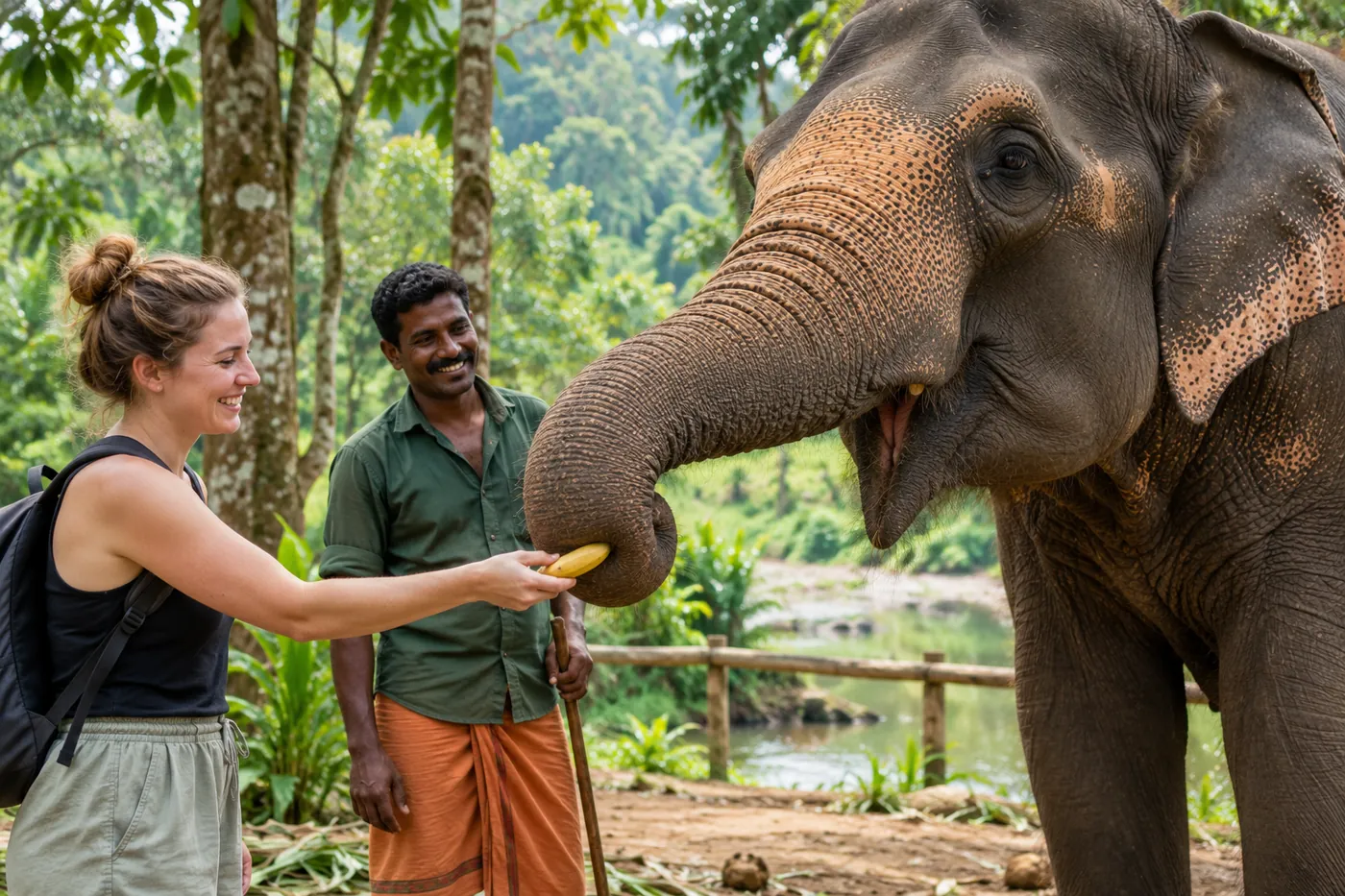
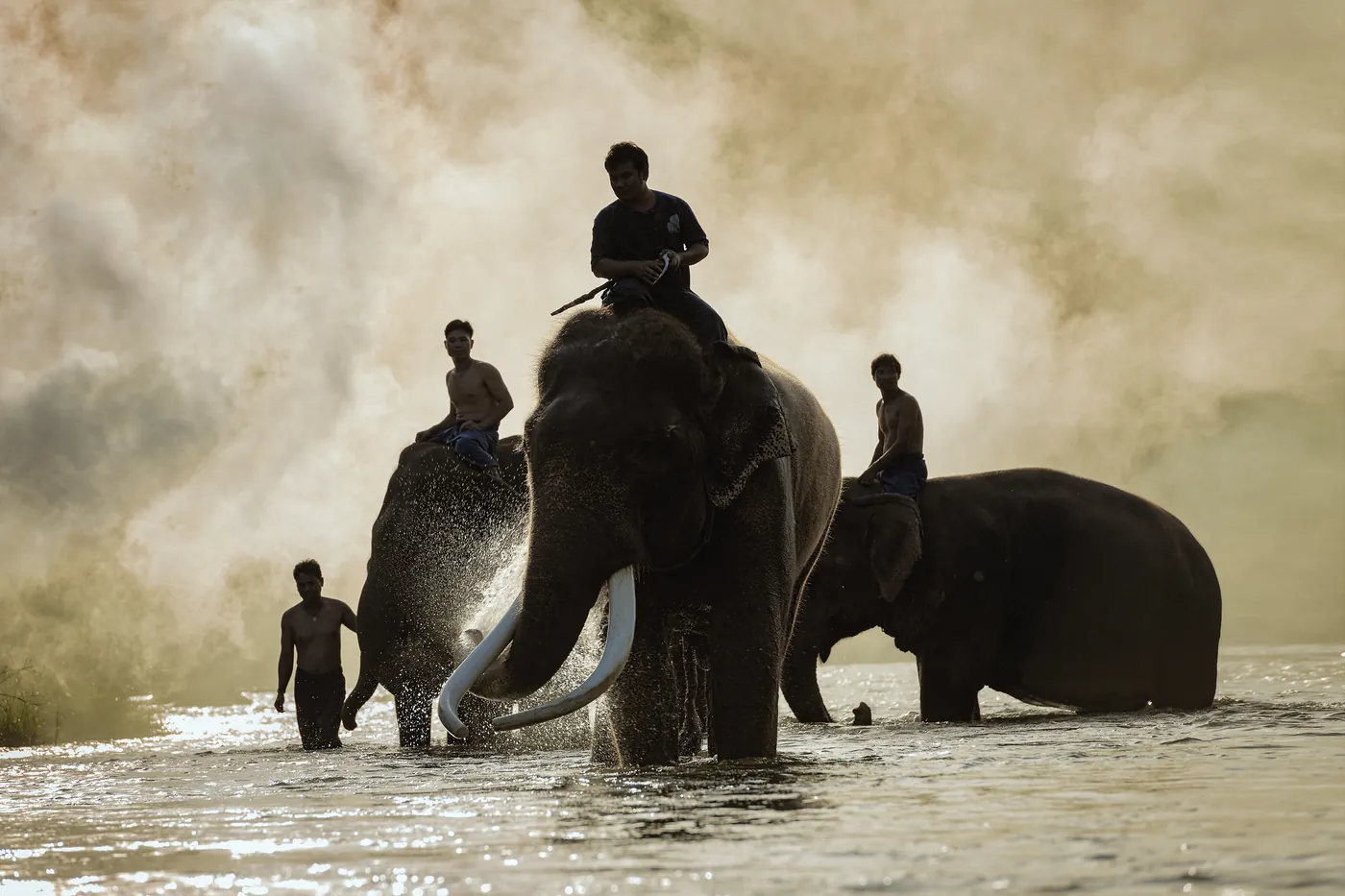
A Kerala elephant sanctuary, in the quiet hours.
Mornings at the sanctuary begin with feeding and a walk to the river for bathing — the elephants unhurried, water splashing, the mahouts who've spent lifetimes with them close at hand and clearly at ease. It's a rare, respectful window into a relationship few outsiders see up close.
An elephant sanctuary can be one of the most moving places you'll visit in Kerala, or one of the most troubling. Captive elephants raise real welfare questions, and practices vary a great deal between centres: some place animals' needs first, while others chain them, use them for tourist photographs or offer rides. That's why we're careful, and why we'd encourage you to be.
The best kind of visit is the quiet kind, and that's what we plan. Early morning is when the elephants are fed and taken to the river for bathing, with the mahouts, the men who have spent their lives caring for these animals, close at hand. There are no performances, no rides and no posing. You watch, learn and, where the centre allows, help with something simple. The pace is calm, and the elephants are allowed to be elephants.
Some guidelines for you: never ask to ride an elephant, don't feed one unless the mahout says it's fine, keep a respectful distance and never touch an elephant without permission. We choose the centres we work with for their welfare standards, and you're welcome to ask us how. It's an early start, but for many people, it's a rare, quiet, humbling morning that they remember for a long time.
We only work with sanctuaries whose welfare standards we've personally checked -- ask us about that if it matters to you.
This experience can be added to a fully personalised itinerary — shaped around your dates, your pace and your interests, never a fixed package. Our signature multi-day journeys go further still: accommodation, meals, transfers and a private guide included throughout, so the only thing left to plan is what you want to feel.
What's the one moment from the sanctuary that's stuck with you?
Photos genuinely do not prepare you. I'd seen elephants at zoos, on TV, all of that, and none of it tells you what it's like to stand a few metres away and realise your whole body is shorter than one of its legs. The first one that walked past me, I actually stepped back without meaning to. You forget how much air they move.
Was there a particular part of the animal that surprised you?
The trunk, completely. You think of it as one thing, like a hose, and it isn't. The tip has this single finger-like point that picks up a fallen leaf as precisely as I'd pick it up with two fingers. Then it curls the whole trunk round a branch and just snaps it like it's nothing. And the breathing. I could hear it breathe through that trunk from where I stood, this long, slow, enormous sound. It didn't feel like an animal noise. It felt like weather.
What about actually being close to it, the skin, that sort of thing?
Rougher than I expected, and dustier. Not smooth at all, deep wrinkles everywhere, and these sparse, wiry hairs poking out that you'd never notice from a photo. Our guide said the wrinkles actually hold moisture and help them cool down, which I'd never once thought about. And the ears never really stopped moving, this slow fan, fan, fan. That's their air conditioning, apparently, all that blood vessel right under the skin.
Did anything genuinely catch you off guard?
The dung, if I'm honest, and not in the way you'd expect. I braced for the smell and there basically wasn't one, more like a farmyard hay pile than anything unpleasant, because it's almost all just crushed plant fibre. The mahout told us it's used to make paper, actual paper, and the pile itself was the size of a football. I've thought about that more than I expected to.
You mentioned a sound earlier, was there more to that?
There was a moment when one of them made this low rumble, and I didn't hear it so much as feel it, right in my chest, before my brain worked out what it was. Our guide said elephants talk to each other in frequencies too low for us to properly hear, over long distances, and that we were basically catching the edge of a conversation. I've never felt sound like that from an animal before.
Any last thing before you left?
This one didn't have tusks, and I actually asked why, assumed all elephants do. Turns out with Asian elephants it's only some of the males, and our guide had a name for the tuskless ones. Small thing, but I liked that I left knowing something true instead of something I'd just assumed. That, and watching the mahout rest a hand on its trunk like you'd rest a hand on an old friend's shoulder. Years together, you could see it. Quiet morning, river mist still on the water. I don't think I've been that quiet in years, either.
Every Raw India Experience begins with a conversation. Tell us what you're looking for — we'll design the rest. No payment is taken here.
A confirmation is on its way to your inbox, and a member of our team will personally reply within 24 hours.
Your data will be secured with us. We will not use it for any promotional activities, and we will delete the data after 100 days of non-communication.