Gallery
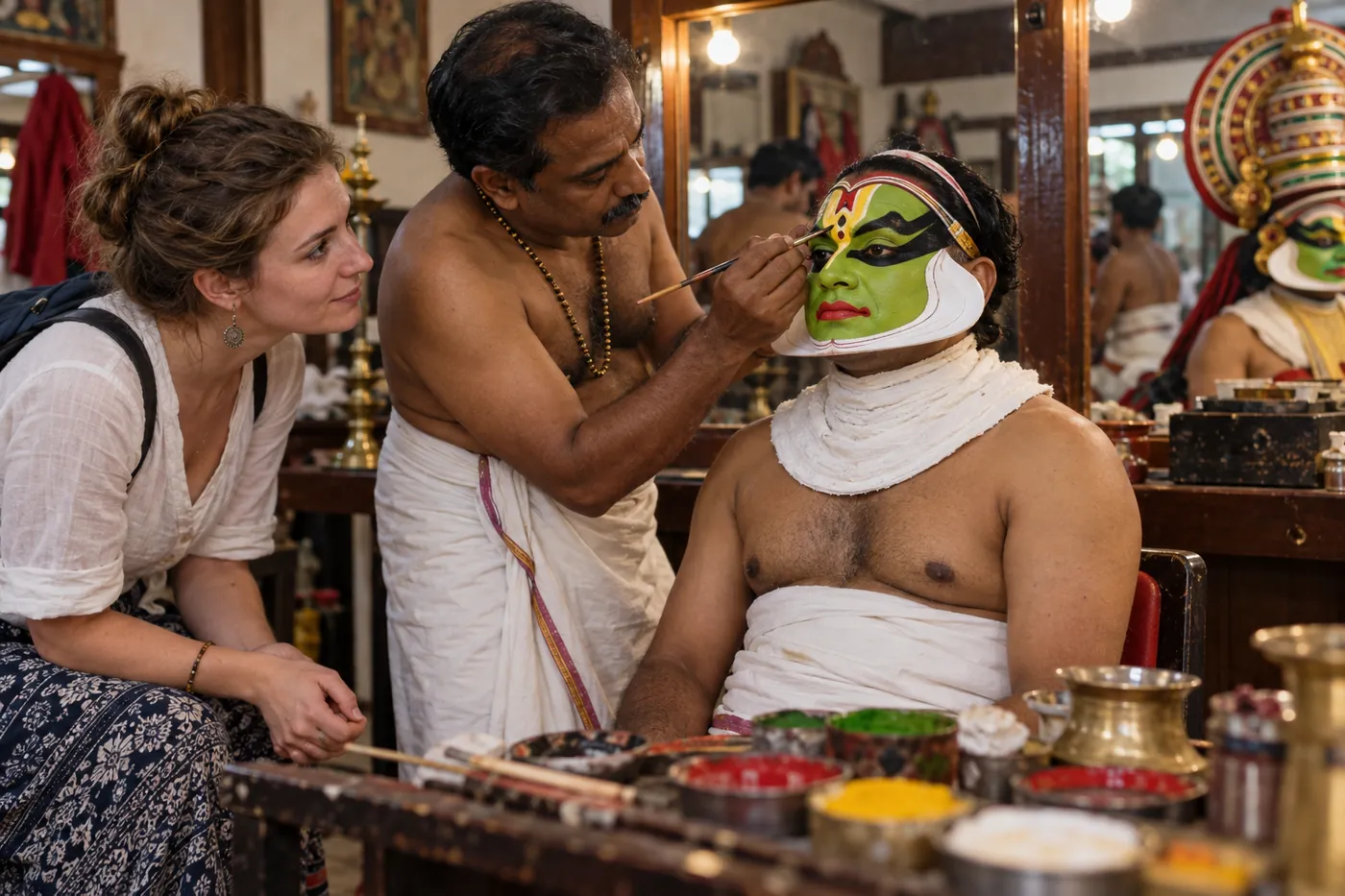
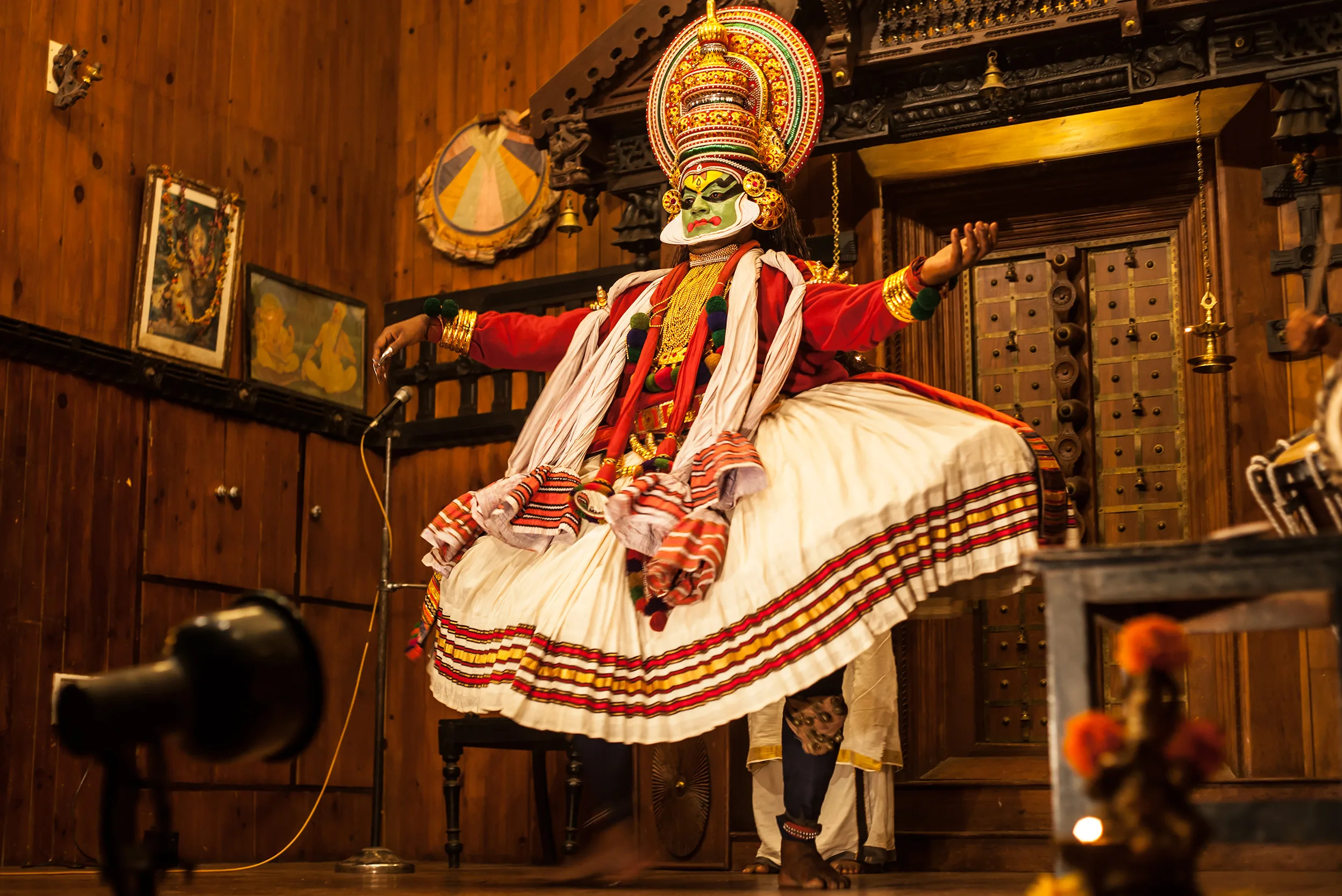
Understand the makeup that turns a performer into a character.
Kathakali's face paint isn't decoration — it's a coded language of colour that tells you who's a hero, a demon, or a divine being before a word is spoken, applied in layers that take hours to perfect. This workshop breaks down that language, step by step, until the mask starts to make sense.
Kathakali's faces are one of the most recognisable images in Kerala, and every line and colour on them means something. A hero is painted differently from a villain, a demon differently from a sage, and the audience can read a character's nature the moment they step on stage. This workshop teaches you that visual language.
An experienced artist explains how the make-up is built up in stages: the base colour, the detailed lines around the eyes and mouth, and the chutti, the raised white border made from rice paste and paper that frames the face. Green marks noble heroes, red-streaked faces mark proud but flawed characters, and each shade has its own logic. The make-up is applied with great care, and the difference between a good hand and a beginner's is instantly visible.
Then you try. The artist will show you what's practical for your group — whether you apply colour to a mask, a sheet, or, in some cases, yourself — and guide you through the basics. It's an intimate, concentrated two hours, and a small taste of the discipline behind the art. Let us know about skin sensitivities before you enquire, since some make-up materials can irritate.
Pairs especially well with a full Kathakali performance the same evening.
This experience can be added to a fully personalised itinerary — shaped around your dates, your pace and your interests, never a fixed package. Our signature multi-day journeys go further still: accommodation, meals, transfers and a private guide included throughout, so the only thing left to plan is what you want to feel.
What was it like learning what the colours actually mean?
More detailed than I expected. Every line near the eyes, every shade, apparently tells the audience exactly who they're looking at before a word is spoken. I'd always just seen it as elaborate costume, not a whole readable language.
Did applying it yourself change how you saw performers afterwards?
Completely. The artist's hand was so much steadier than mine, and watching my own attempt smudge slightly where hers never would have, gave me a real sense of the years of practice behind a performer's face on stage.
Was there a specific technique that was harder than expected?
The chutti, the raised white border, apparently takes real specialist skill to build properly with rice paste, and our artist just laughed gently when I asked to try that part myself. Some things, she said, take years, not an afternoon.
How did it feel seeing the finished result on yourself, or on the surface you worked on?
Strange and a little thrilling. Even a rough, beginner version of that face looking back at me made the full performances I'd later see feel entirely different, because I now had some sense of the hours sitting behind that transformation.
Every Raw India Experience begins with a conversation. Tell us what you're looking for — we'll design the rest. No payment is taken here.
A confirmation is on its way to your inbox, and a member of our team will personally reply within 24 hours.
Your data will be secured with us. We will not use it for any promotional activities, and we will delete the data after 100 days of non-communication.