Gallery
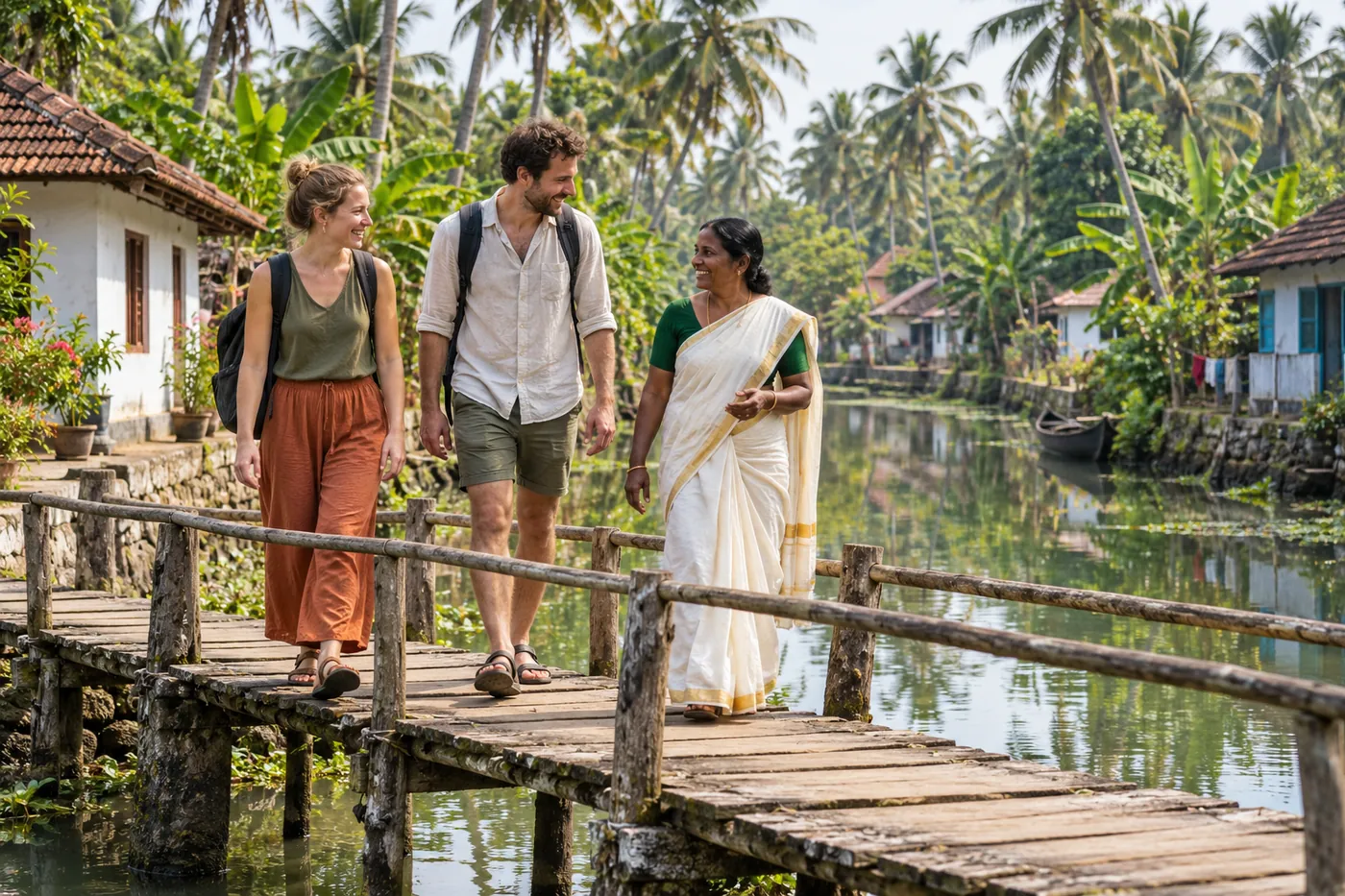
Half boat, half on foot — Kerala the way locals move through it.
Some parts of backwater village life are only reachable by water, others only on foot. This experience switches between country boat and quiet pathways, following the same routes villagers use daily between home, market, and field — past drying fish, children cycling home from school, a temple bell somewhere in the distance. You leave with a real sense of how a place actually works, not just how it looks.
A village boat walk is the backwaters at the pace of a conversation. You start in a country boat, slip through waterways too small for anything with an engine, and then step out and continue on foot — along the earthen bunds that divide the paddy fields, past coconut groves, over little footbridges, through a village that is simply going about its Tuesday.
The bunds are the heart of it. They are the raised mud walls that hold the water where it's wanted, and walking along one, with green fields on one side and a canal on the other, is the best way to feel how this landscape was built by hand. Along the canals you may pass small boats selling vegetables and fish to households on the bank — a floating shop round, still working the way it always has.
Walking through people's villages is a privilege, and we treat it like one. Our guides are from these communities, they know who to greet and where not to point a camera, and they'll teach you the easy things — a smile, a Malayalam hello — that turn strangers into neighbours for the afternoon. We keep the group small so the village doesn't feel visited so much as briefly joined.
This is the route a resident would take, not a route built for visitors.
This experience can be added to a fully personalised itinerary — shaped around your dates, your pace and your interests, never a fixed package. Our signature multi-day journeys go further still: accommodation, meals, transfers and a private guide included throughout, so the only thing left to plan is what you want to feel.
What surprised you most about walking on the bunds?
That they're basically handmade dams, mud walls built to keep water out of the fields, and I was walking along the top of one with a paddy field on one side and a canal on the other. Our guide made me stop and really look at how much of this landscape is engineered by hand, not natural at all.
Was there a moment that felt properly local, not staged for visitors?
A small boat came round the bend selling vegetables and fish straight to people's doorsteps, this floating shop making its rounds exactly like it probably has for decades. Nobody looked up. It wasn't for us, we just happened to be walking past it.
Did you actually talk to anyone in the village?
Our guide taught me one Malayalam word for hello before we even got out of the boat, and using it on an old man sitting outside his house got me the biggest smile of the whole trip. Small thing, cost nothing, changed the whole interaction.
How did it feel walking through someone's actual village rather than a sight?
Ordinary, in the best way. Someone was hanging washing, kids were kicking a ball near the temple, and we were just quietly part of the scenery for an afternoon rather than the main event. I liked that we weren't the interesting thing happening that day.
Every Raw India Experience begins with a conversation. Tell us what you're looking for — we'll design the rest. No payment is taken here.
A confirmation is on its way to your inbox, and a member of our team will personally reply within 24 hours.
Your data will be secured with us. We will not use it for any promotional activities, and we will delete the data after 100 days of non-communication.